


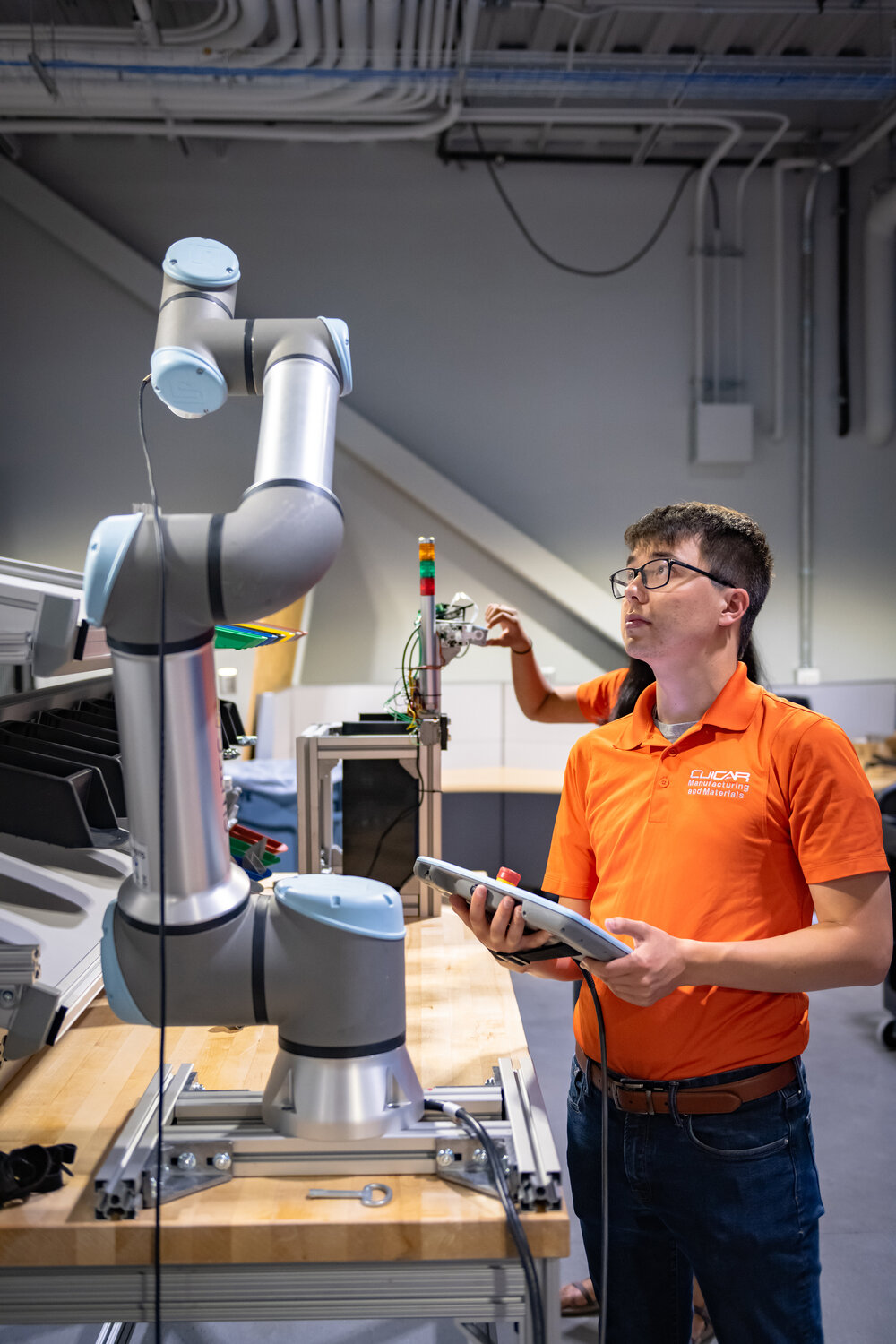


Imagine walking into a restaurant and having a robot server, or taking a tour of a local auto plant and seeing humans and collaborative robots working together on the assembly line.
South Carolina businesses and manufacturers are evolving their workforce through the use of robotics and collaborative robots, or “cobots.”
South Carolina’s auto manufacturers are leading the way, as are a few restaurants where food is delivered via a robot that rolls over to take your order and returns with your food.
“The name ‘cobot’ was first developed out of the concept of having robots and humans work side-by-side on the manufacturing floor,” said Yue Wang, an associate dean for research at Clemson University’s College of Engineering and Applied Science (CECAS) and the Warren H. Owen – Duke Energy Professor of Engineering at Clemson in Clemson, South Carolina.
“This is not restricted to the manufacturing facility,” Wang said. “Robotics and AI work with humans all the time and always in the human environment.”
People who drive an autonomous vehicle like Tesla’s cars are using robotics in a human environment. Soldiers who work with drones are working with robotics.
Robots that work with humans in doing work, such as robots assembling parts with human workers, can be called cobots, said Yunyi Jia, the McQueen Quattlebaum professor of automotive engineering at Clemson.
“If you go to a restaurant, you may have your food delivered by robots,” Wang said. “The restaurant robot may have sensors to perceive if there’s an obstacle in its way, and they’ll stop and avoid humans. That shows how humans and robots interact with each other.”
Successful integration of robotic technology in the workplace depends partly on how employers are framing the introduction of robotics and cobots, said Richard Pak, a professor and director of the Human Factors Institute at Clemson University in Clemson.
“Are you framing it as a teammate or a tool? Once you set expectations, it will affect everything down the line from how people react to how the cobot/robot behaves,” Pak explained. “Is it competition? A hindrance? Or is it something I should give more leeway to?”
Employers need evidence-based information and training to help them frame technological changes in ways that ensure workers and cobots work well together, and this is where Clemson University’s researchers and faculty can help because of their labs that study and develop cobot technology.
Their work is helping local industry, such as BMW and other automakers, integrate cobots into their plants by helping them improve through the design of robotic systems, Jia explained.
“We can help them build a cobot system,” he said. “For cobots, safety is first, and second is efficiency – making sure the robot gets the job done efficiently.”
The third goal is comfort, which ensures employees will work with the robot, Jia said.
“Few people talk about comfort, but if human workers do not like it, they will not work with them or they would not work efficiently with them,” he explained.
“I always tell my students that our goal is to make the robot and have it do the right thing at the right time, in the right way," he said.
For example, some robots are capable of working very quickly, but if their speed is prioritized in a workplace setting that includes human workers, there could be a problem as the humans working there may be uncomfortable with speedy cobots. Too fast could also be unsafe, and safety is the first priority.
This doesn’t mean that all manufacturing floors could one day work faster without any human workers, because humans still have important roles.
There are multiple examples of this in South Carolina’s manufacturing plants, including an example from an auto manufacturing facility where cobots are introduced to the manufacturing floor to clean dust off of car frames.
Cleaning welding dust is difficult and kind of a dead-end job for human workers because it requires continuously holding a vacuum to clean the car body even as the body is moving on the assembly line. It’s safer and more efficient to delegate that work to cobots, Jia noted.
After cobots clean off welding dust, human workers inspect the cobots’ work and either do additional cleaning or send it to the next step when it’s ready, Jia said.
That example shows how cobots can help on jobs that human factory workers do not like. But then, the human workers are needed to help with quality assurance of the robotic work.
Wang visited an automotive plant about six years ago and witnessed how well human employees can work with robotic workers.
“We saw how cobots were deployed to work with human associates,” Wang said. “There is a workstation with one human and one cobot; the human does some task the human is good at, and the next workstation has the cobot doing relatively straightforward automation tasks that are better-designed for robots.”
Humans and cobots co-exist when people pick the task that is most cost-efficient for them to do, and when cobots are programmed for the most cost-efficient tasks for them to run.
These human-cobot workplaces work best when both cobots and humans are trained to work together.
“A collaborative robot is designed to safely work with humans to complete a task; it has certain strengths when compared to humans,” said Kapil Chalil Madathil, the Wilfred P. Tiencken endowed professor of industrial engineering at Clemson.
“How much do (human workers) trust the automation and technology and how that interface is designed to work with that particular machine?” Madathil said. “Can you talk with the robot and say, ‘Here, robot, do this particular task?’ or do you use an iPad to interact with the machine, or do you have technology within the cobot that can look at what the human is doing and support that particular task in an intelligent way?”
This is where researchers come into the picture: “I wear a hat for director of workforce development at Clemson, where we’re translating these into the actual work environment,” Madathil explained. “Some of the biggest challenges we have seen are poorly designed (human) interactions with robots or machines.”
Performance is poor when human-cobot interactions are not well-planned. The goal is to augment cobots and enhance human capability, and this can be done through a company’s training program, as well as through South Carolina’s two-year technical colleges, he said.
“Companies probably want to invest in training programs that are supported by the state to ensure their workforce is trained to use these technologies,” Madathil said.
Technical colleges have programs in advanced manufacturing that help train students to work with robotics, and the state supports this workforce training and transformation, he said.
“ReadySC is the workforce development arm in South Carolina, and they’re doing a phenomenal job with the right kind of training and training programs to ensure our workforce is well-trained to use these kinds of technologies in an actual work environment,” Madathil said. “The majority of the programs and manufacturers are hiring from these two-year programs, and they help manufacturers improve productivity.”
South Carolina programs, working with colleges and employers, have helped to maintain the state’s recruitment pipelines. But training efforts are evolving with advanced robotics and AI and the need to continuously ensure manufacturers can hire workers with the right skills and potential.
“When humans are introduced to new technologies, we develop trust over time; it goes up and goes down until it settles into a level that works,” Pak said. “That’s not a foreign concept. We do that with people, too.”
Without trust, employers face backlash. Employees may avoid collaboration with robotic technology, and the workplace might become less safe. Their reasons for this could be a fear of the robot or cobot taking over their job or because the tasks the cobot does are not ones the employee wants to give up.
“One tension in human-automation interaction is (when) you’re introducing this tool that is taking over this task that is not a problem (for the employee),” Pak explained. “The robot is taking it over and now (they) have to adjust (their) work and do more repetitive stuff.”
Employees might ask why not have the cobot do tasks that are more repetitive or unsafe and allow humans to do the other tasks, he said.
Employers might pay more attention to what the robot can do and what part of the task is unsafe or unpleasant or repetitive and is something humans do not like to do, and then have the robot do that type of work.
It’s like the words of an artist posting on social media about AI: “I would like AI to clean my house so I can spend more time creating, instead of creating so I have more time for housework.”
Pak saw that quote on BlueSky and found it incredibly insightful: “A lot of technologies are taking over stuff we like to do and not what we don’t want to do,” he said.
An obstacle to successful workplace integration of cobots and robotics is robotic developers’ imagination versus engineering/technological capability. Some robotic developers and manufacturers want to show how much their robots can do and give too little thought to what the people who work with robots want them to do, Pak noted.
Employers need to keep in mind that workers will have a range of reactions to new robotics in the workplace. Some will not trust technology, and others may have little difficulty adjusting.
It’s important to build trust among employees. One way to do this is to ease people into the workplace with new robotics by giving them low-stakes exposure, allowing workers to observe what robots can and cannot do. It’s a slow process, but it will help prevent backlash and collaboration problems, Pak explained.
“We are not robots and we don’t all behave the same,” Pak said. “Maybe targeted training – giving experienced workers more low-risk exposure and reassurance that their jobs are safe – is needed.”
SIDEBAR
How to Train Cobots and People to Work Well Together
By Melinda G. Young
Clemson University professors and students have been researching new and better ways to train people and cobots to work together in ways that enhance safety and efficiency.
“We try to make humans understand cobots, too,” said Yunyi Jia, the McQueen Quattlebaum professor of automotive engineering at Clemson.
Recognizing what cobots would do and how they would do it is critical to making cobots work well with human workers, Jia said.
Cobots are trained to adapt to humans and anticipate their movements. But people also need training, which can increase their collaboration performance with cobot coworkers, Jia said.
One method Jia’s lab has been exploring is training through a virtual robot.
“We have a patent on this and are in the process of commercializing this technology,” Jia said. “We train people to work together with robots through a virtual robot overlap with a real robot.”
This is how it works: The human worker wears mixed-reality goggles that show them what the robot is about to do. There is a short delay between when the worker sees a virtual overlapped cobot moving to pick up a tool and when the physical cobot actually lifts its electronic arm to pick up the tool. Think of it as the same as live TV programming delays of one to 10 seconds. That period of time gives the human notice to move if they are in the path the cobot is taking or to prepare for their part in the next step the cobot is taking.
Training people to work with cobots and advanced robotics often begins in high school or at technical colleges through the state’s workforce development programs.
ReadySC, part of the South Carolina Technical College System, works with 16 technical colleges to prepare the state’s workforce. Greenville Technical College, Trident Technical College, Piedmont Technical College, and Central Carolina Technical College are among the schools in the program.
South Carolina also offers Apprenticeship Carolina, which has given 55,500 apprentices on-the-job work experience since 2008. There also is a youth apprenticeship movement for students, and SC Technical College System recently introduced a new initiative, called the pre-apprenticeship program to prepare people to enter a registered apprenticeship program and help improve skills among workers.
Another step in improving collaboration between humans and robots is to train technicians and engineers to work alongside automation, along with the cobot, said Kapil Chalil Madathil, the Wilfred P. Tiencken endowed professor of industrial engineering at Clemson.
The key to success with this technological shift is for employers to train both cobots and human employees to work together as safely, efficiently, and collaboratively as possible, he said.
“We should invest in training programs of that kind, especially when we have a lot of AI-assisted programs coming into play,” Madathil said. “We should ensure we have the right kind of workforce as these kinds of technologies are being increasingly incorporated into the workplace.”
That kind of training evolution begins in high school when families, educators, and employers think about the kind of skills students will need to be employed at jobs in the AI/robotics era.
The basic need is for future workers to have good problem-solving skills, and every educational institution should be teaching students how to solve problems, he said.


Comments
No comments on this item Please log in to comment by clicking here